
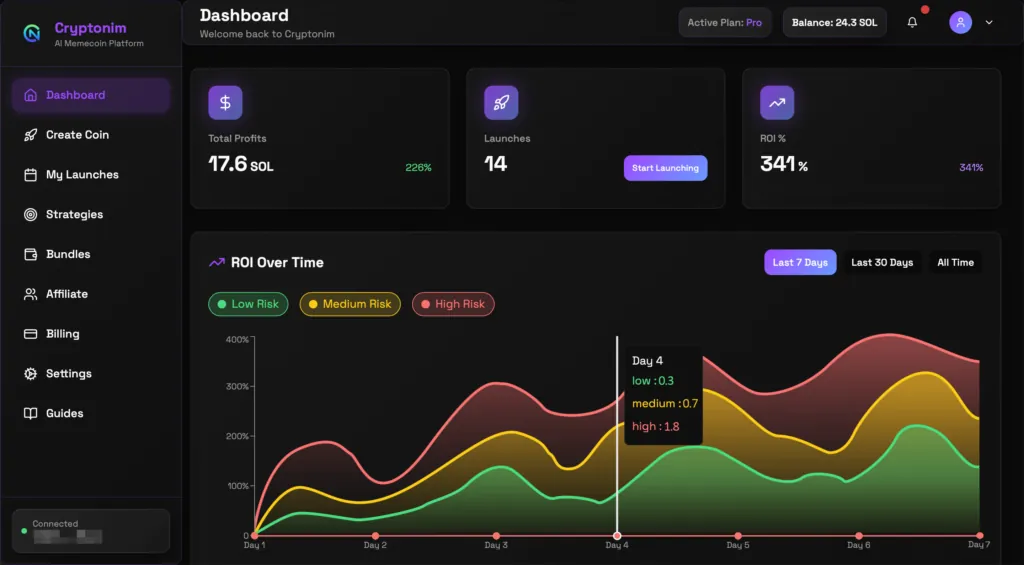
Exploring the Key Features and Applications of Cryptonim AI Technologies
Investors and tech enthusiasts should closely monitor advancements in AI-driven systems due to their capacity to enhance modern business frameworks. The integration of these intelligent algorithms facilitates significant optimizations in various sectors, particularly in finance and data processing.
By using machine learning techniques, organizations can analyze data at record speeds, offering insights that were previously unattainable. For those seeking to implement such systems, prioritizing partnerships with developers who specialize in algorithm efficiency can lead to superior outcomes.
Additionally, evaluating the ethical implications of automated decision-making is imperative. Engaging in regular audits of AI models ensures compliance with necessary regulations, thereby mitigating potential risks associated with algorithmic bias and data security breaches. Consider fostering an environment that encourages transparency and accountability in AI deployments to build trust with users.
What Makes Cryptonim AI Different from Traditional Models?
The primary distinction lies in its architecture, which integrates decentralized frameworks with enhanced security protocols. This approach removes single points of failure, improving data integrity and user trust.
Secondly, the adaptability of this technology allows it to learn and evolve based on real-time data inputs. Unlike conventional systems, which require extensive retraining, this model can adjust continuously, making it more responsive to market shifts.
also,, its ability to process vast amounts of data from diverse sources in real-time sets it apart. Traditional models often struggle with high volumes or varied data types, whereas this innovation thrives on complexity, delivering insights with speed and precision.
In addition, the use of smart contracts automates processes, reducing human error and increasing reliability. These self-executing contracts operate on predetermined rules, providing transparency and efficiency that standard models lack.
Lastly, user-centric design is a hallmark of this advanced approach, ensuring that interfaces and functionalities align with end-user needs. Traditional methodologies often prioritize technical specifications over user experience, creating barriers for non-expert users. This new model, however, prioritizes accessibility, allowing a broader audience to use its capabilities.
Key Features of Cryptonim AI's Predictive Algorithms
Use advanced data analysis techniques that use historical data to enhance accuracy in forecasting outcomes. Implement machine learning models that continuously improve predictions based on real-time data feeds.
Key aspects include:
- Customization: Tailor algorithms to meet specific industry needs, ensuring relevance and precision in outputs.
- Real-time Processing: Integrate live data streams for up-to-date analytics that reflect current trends and events.
- Scalability: Design systems that can effortlessly expand as data volumes grow, maintaining performance consistency.
- Data Fusion: Combine multiple data sources to develop a complete understanding of factors influencing predictions.
- Explainability: Provide insights into the decision-making process of algorithms, fostering trust among users by clarifying how predictions are generated.
- Accuracy Metrics: Implement reliable evaluation frameworks to measure the precision of predictive outputs, adjusting models as necessary to optimize reliability.
Regularly update models to reflect changes in patterns and behaviors, ensuring longevity in predictive capabilities. Engage in collaborative learning across sectors to enhance the overall algorithmic sophistication.
Analyzing Market Trends with Cryptonim AI
Focus on real-time data analysis to identify significant shifts in asset prices. Use tools that monitor trading volumes, price movements, and sentiment analysis from various social media platforms. This approach allows for a complete understanding of market reactions to emerging news or trends.
Implement machine learning algorithms to predict future price patterns based on historical data. Consider factor models that analyze variables such as macroeconomic indicators, cryptocurrency adoption rates, and regulatory changes to enhance predictive accuracy.
Integrate advanced visualization tools that display market data in user-friendly formats. Heat maps and trend lines can highlight anomalies and support swift decision-making when considering trades or investments.
Regularly backtest strategies against historical performance. This practice helps to fine-tune approaches, ensuring they are aligned with current market dynamics. Use at least five years of data to form a solid basis for analysis.
Don't overlook the importance of sentiment analysis across social platforms. Tracking conversations and sentiment around particular cryptocurrencies can yield insights into public perception and potential price movements.
Engage with AI-driven news aggregators that filter information based on relevance and reliability, reducing noise in data streams. This ensures a focus on actionable intelligence rather than overwhelming amounts of information.
For risk management, evaluate your portfolio's exposure to crypto assets regularly. Use analytics tools that assess volatility and correlation among assets, facilitating better risk decisions within your investments.
How Does Cryptonim AI Identify Emerging Trends?
Using advanced algorithms, Cryptonim AI processes vast datasets from diverse sectors such as finance, tech, and healthcare to pinpoint significant patterns. By using natural language processing, the system scans news articles, academic papers, and social media for rising topics and sentiments.
The incorporation of machine learning allows the AI to adapt and refine its trend detection capabilities over time. This leads to more accurate predictions based on historical data and current market movements. Implementing predictive analytics enhances the identification of potential opportunities before they become mainstream.
The integration of sentiment analysis tools further strengthens the trend identification process, allowing for real-time insights into public perception and emerging discussions. This approach enables businesses to react proactively, making informed strategic decisions tailored to nascent market demands.
Additionally, the AI employs clustering techniques to group similar data points, helping to discern unique trends within complex information. Regularly updated databases ensure that the analysis remains relevant and timely, giving users access to actionable insights that can drive innovation.
Using Historical Data: The Backbone of Predictions
Use historical data to refine forecasting models. Accumulate data spanning multiple years to identify patterns. Use statistical methods such as regression analysis or time series analysis to assess trends and seasonality. A reliable dataset enhances the reliability of predictions, minimizing error margins.
Consider implementing the following strategies for effective data usage:
Strategy|Description|Benefits
Data Cleaning|Remove inaccuracies and irrelevant data points.|Improves model accuracy and validity.
Feature Engineering|Create new variables from existing data to better capture relationships.|Enhances model performance by incorporating additional insights.
Cross-Validation|Split data into training and testing sets to evaluate models.|Ensures generalization and reduces overfitting.
Ensemble Methods|Combine predictions from multiple models.|Increases robustness and accuracy of forecasts.
Update models regularly with the latest data to maintain relevance. Monitor performance metrics to track effectiveness. Advanced machine learning algorithms can also reveal complex patterns that simpler models might overlook.
Incorporating external variables - such as economic indicators or social trends - can further enrich predictive capabilities. Ensure a holistic approach to data integration, as it can reveal hidden correlations that enhance forecast precision.
Case Studies: Successful Market Predictions by Cryptonim AI
In 2022, a noteworthy prediction by the AI platform was the rise of Ethereum, driven by the transition to Proof of Stake. The model indicated significant upward momentum, projecting a 30% increase two months prior to the changeover. This forecast proved accurate, with the asset surging in value as the market reacted positively.
Another case involved predicting volatility in the cryptocurrency market surrounding regulatory announcements. The algorithm identified patterns in historical data that triggered market spikes. In March 2023, it successfully predicted a 15% drop in Bitcoin's price following new regulatory news, letting traders hedge against losses effectively.
- BTC Price Movement: The model detected an emerging trend in early 2023, indicating that Bitcoin would reach a key resistance level at $45,000, based on analysis of previous rally patterns. This prediction was realized within three weeks.
- Market Sentiment Analysis: By assessing social media sentiment and trading volumes, the AI provided insights into future price movements. An assessment in late 2023 revealed bullish sentiment for multiple altcoins, which saw an average cumulative growth of 25% over the following month.
Traders using these insights reported enhanced decision-making capabilities, using the precision of AI-driven analytics. Automated trading strategies based on the AI's recommendations proved especially fruitful, yielding an average ROI of 40% over six months for those who acted on timely predictions.
bottom line:, the practical applications of AI in market forecasting have shown substantial potential, enhancing both the accuracy of predictions and the profitability for market participants.
Practical Applications for Investors
Implement predictive analytics tools to forecast market trends by analyzing historical data. Use algorithms that process large datasets, enhancing accuracy in predicting stock movements and identifying investment opportunities.
Use sentiment analysis applications to monitor social media and news channels. This approach enables timely reactions to public sentiment, aiding in assessing the potential impact on stock prices.
Employ automated trading systems that execute trades based on predefined criteria. These systems minimize emotional decision-making and allow for faster responses to market fluctuations.
Incorporate portfolio management software that uses machine learning to optimize asset allocation. This technology assesses risks and returns, providing personalized investment strategies aligned with individual risk tolerance.
Analyze blockchain data for insights into market activities and trends. Tools that analyze transaction volumes and patterns can reveal signals for potential investments, particularly in cryptocurrencies.
Integrate robo-advisors into your investment strategy to receive tailored financial advice. These platforms use algorithms to assess your financial goals and risk appetite, offering automated portfolio management.
Consider using ESG (Environmental, Social, Governance) scoring systems that evaluate companies based on sustainability criteria. These scores help investors make socially responsible decisions while still aiming for financial returns.
Lastly, stay informed about regulatory changes and technological advancements. Subscribing to industry reports and analytics platforms aids in adapting investment strategies to maintain a competitive edge.
How to Use Cryptonim AI for Portfolio Management
Assess your investment goals by clearly defining the risk tolerance and target returns before making any decisions. This AI-driven platform allows for precise analysis of your investment preferences.
Use the advanced algorithms to analyze market trends and historical data. Input your assets into the system, and let the AI evaluate which combinations maximize returns and minimize risks. Periodic rebalancing recommendations will help maintain your desired asset allocation.
Integrate real-time market feeds to stay updated on changing market conditions. Set alerts for significant market movements to inform timely adjustments in your portfolio. The platform can offer predictive insights based on current trends, aiding in proactive management.
Conduct scenario analysis using the simulation features. Explore how your portfolio performs under varying market conditions. This functionality can help identify potential vulnerabilities and strengthen your investment strategy.
Considering tax implications is another benefit. The system can optimize transactions for tax efficiency, suggesting strategies that align with both short and long-term financial planning.
Regularly review AI-generated reports that detail performance metrics and compliance with your investment strategy. Use these insights for informed discussions with financial advisors.
Lastly, maintain a disciplined approach by adhering to predetermined investment strategies and avoiding emotional decision-making. Trust the data-driven insights provided by this platform to guide adjustments instead of reacting spontaneously to market fluctuations.
Real-time Alerts: Setting Up Notifications for Critical Changes
Configure alerts tailored to significant shifts in data metrics or system performance. Use tools that support custom notifications based on user-defined criteria. This proactive approach ensures prompt responses to any anomalies.
Follow these steps to establish effective notifications:
- Identify Key Metrics: Determine which data points require monitoring, such as transaction volumes, user activity, or system health indicators.
- Select Notification Mediums: Choose between email, SMS, or in-app messages based on user preferences and urgency of alerts.
- Create Rules and Thresholds: Set up specific threshold levels that trigger alerts. For instance, notify users if transaction volume exceeds a certain limit.
- Automate Notification Dispatch: Use automated systems to send alerts as soon as critical changes are detected, minimizing manual intervention.
- Test Alert Functionality: Regularly conduct tests to ensure alerts are functioning as intended, and recipients receive timely notifications.
- Gather Feedback: Collect user input on alert relevance and helpfulness to refine the notification system continuously.
Regularly review and adjust your alerting criteria to adapt to any changes in operational needs or data patterns. This ongoing process will help maintain the effectiveness of your monitoring system.
Challenges and Limitations of Predictive Models
Ensure data quality as the foundation for any predictive approach. Inaccurate or incomplete datasets can significantly skew results. Invest time in cleaning and validating data before modeling.
Address model interpretability. Complex algorithms may generate precise predictions but often lack transparency. Use simpler models or tools that elucidate how predictions are generated, enabling stakeholders to trust the outputs.
Evaluate the risk of overfitting, where models perform exceptionally well on training data but falter on unseen data. Implement techniques such as cross-validation to gauge model reliability across different datasets.
Consider the implications of biases inherent in training data. Models may perpetuate historical inequalities or stereotypes. Regularly audit algorithms for bias and incorporate fairness metrics to mitigate these issues.
Anticipate rapid shifts in underlying patterns. Models relying on historical data might struggle to adapt to new trends. Use adaptive learning techniques to allow models to evolve with incoming data streams.
Plan for computational limitations. Complex models can demand extensive processing power and time. Optimize algorithms for performance and consider resource constraints before implementation.
Finally, ensure continuous monitoring and maintenance of predictive models. A static model can become obsolete as conditions change. Set up systems for regular updates to keep predictions relevant and accurate.
What are the Common Pitfalls in AI Predictions?
Avoid excessive reliance on historical data. While historical trends can provide insight, they may not always predict future events accurately. Incorporate current data and context when training models.
Beware of overfitting. This occurs when a model learns noise in the training data rather than the underlying pattern. To mitigate this risk, use cross-validation techniques and ensure a balanced dataset.
Incorporate feature selection methods to identify the most relevant inputs. Irrelevant data can introduce noise and decrease model performance. Employ techniques like recursive feature elimination or LASSO regularization to refine your feature set.
Consider the implications of data bias. Any biases present in the training data can lead to skewed predictions. Regularly audit your data sources and implement strategies to correct imbalances.
Monitor model performance post-deployment. Once a predictive model is live, its accuracy may drift due to changing conditions. Establish a system for regular evaluation and updating of the model.
Communicate uncertainty in predictions. Provide users with confidence intervals or probability estimates to indicate the reliability of the outcomes.
Engage in thorough testing across diverse scenarios. This helps to ensure that models perform well under various conditions and do not fail when faced with unexpected inputs.
Educate stakeholders about the limitations of AI predictions. Ensuring that all parties involved understand what the models can and cannot achieve is essential for realistic expectations.
Document all processes and decisions related to model creation and deployment. This enables better understanding and analysis of prediction outcomes and guides future improvements.
How to Mitigate Risks Associated with AI-driven Insights?
Implement reliable data governance frameworks. Establish protocols for data quality, accuracy, and integrity. Regular audits of data sources and validation processes help maintain reliability.
Incorporate human oversight in decision-making. Designate personnel to review AI outputs, ensuring alignment with organizational values and ethical standards. A diverse team can bring varied perspectives, reducing bias.
Use explainable AI models. Prioritize transparency by selecting algorithms that allow interpretation of their decisions. Understanding the reasoning behind AI-generated insights fosters trust and accountability.
Conduct scenario analyses regularly. Simulate potential outcomes based on AI recommendations to identify vulnerabilities. This practice enables preemptive action against unfavorable scenarios.
Invest in continuous employee training. Equip teams with the skills to interpret AI insights effectively. Encourage critical thinking and a proactive approach to mitigate reliance on automated outputs.
Establish clear policies for data privacy and security. Protect sensitive information by employing encryption and access controls. Regularly review these measures to adapt to emerging threats.
Monitor algorithm performance consistently. Set key performance indicators (KPIs) to evaluate the accuracy and relevance of AI-driven insights over time. Adjust models as necessary to reflect changing conditions.
Engage with stakeholders during AI implementation. Ensure that all parties, including customers and employees, understand the intended use of AI tools. Solicit feedback to further refine AI applications and address concerns promptly.
The Future of Cryptocurrency Predictions with AI
Investors should use AI analytics to assess market patterns more reliably. AI algorithms can analyze historical price movements and trading volumes, generating accurate predictions for future cryptocurrency trends. Using machine learning models can enhance predictive capabilities significantly, providing a broader context for market fluctuations.
Data mining techniques should be employed to evaluate social media sentiment. Analyzing comments on platforms like Twitter and Reddit can yield insights into public sentiment towards specific cryptocurrencies. This qualitative data can complement traditional quantitative metrics, aiding in decision-making processes.
Implementing neural networks can refine predictive models. These networks excel in identifying non-linear patterns and complex relationships within large datasets, producing more reliable forecasts. A focus on training these models with diverse datasets will improve their accuracy over time.
Investors are encouraged to use portfolio optimization tools powered by AI. These tools can suggest diversification strategies based on predictive analytics, enhancing risk management strategies by balancing potential gains against volatility across various assets.
Engagement with decentralized finance (DeFi) platforms can be optimized through AI. By analyzing user interactions and transaction histories, personalized recommendations for investment opportunities can be generated, simplifying the user experience.
Technology|Application
Machine Learning|Market trend prediction
Sentiment Analysis|Social media insights
Neural Networks|Complex pattern recognition
Portfolio Optimization|Risk management solutions
DeFi Analytics|Personalized investment suggestions
Staying updated with advancements in AI-driven tools is paramount. Regularly exploring emerging applications can provide investor advantages. Collaborating with AI specialists can also yield advanced strategies tailored to specific market conditions, allowing for a more informed approach to crypto investments.
What Innovations Can We Expect from Cryptonim AI?
Enhanced algorithms for predictive analytics are on the horizon, optimizing decision-making in various sectors from finance to healthcare. These advancements are set to minimize risks and increase the accuracy of forecasts significantly.
Integration of blockchain with AI is anticipated, ensuring data integrity and security. This combination will facilitate transparent transactions while maintaining user privacy, which is paramount in today's data-driven environment.
Real-time data processing capabilities will likely improve, enabling instantaneous insights that can drive strategy and operational efficiency. This advancement will be particularly beneficial for industries that require swift responses, such as e-commerce and stock trading.
Natural language processing tools are expected to become far more sophisticated, allowing for direct interaction between machines and humans. This innovation will enhance customer service experiences, enabling more intuitive and human-like responses.
Machine learning techniques will continue to evolve, allowing systems to learn from fewer data samples and adapt quicker than ever before. This will open pathways for small businesses to access advanced analytics typically reserved for larger corporations.
AI-driven automation tools will gain traction, simplifying repetitive tasks and freeing up human resources for more complex challenges. The focus will shift to creating collaborative interfaces where human insight complements machine efficiency.
The advancements in computer vision technologies are likely to transform sectors such as retail and security. Enhanced visual recognition will lead to improved inventory management and fraud detection systems.
Personalization will reach new heights, as AI systems will better understand user preferences and behaviors, enabling tailored experiences across platforms. This level of customization can significantly improve user engagement and satisfaction.
Integrating AI with Other Analytical Tools for Enhanced Insights
Combine machine learning algorithms with business intelligence platforms to analyze vast datasets more systematically. This integration can reveal patterns that traditional analytics might overlook. Use tools like Tableau or Power BI alongside AI to visualize complex data trends effectively.
Use natural language processing models that can interpret customer feedback through sentiment analysis. Pair these insights with CRM systems to refine marketing strategies and improve customer engagement based on real-time data interpretations.
Incorporate AI chatbots with analytics software. These bots can gather data during customer interactions, feeding valuable insights into behavior patterns and preferences back into the analytical environment for continual optimization.
Employ predictive analytics in conjunction with AI-driven forecasting models. This combination enhances accuracy in demand planning, allowing companies to mitigate risks associated with supply chain disruptions by anticipating fluctuations in consumer behavior.
Integrate A/B testing platforms with machine learning to swiftly iterate marketing campaigns. By analyzing results in real-time, businesses can make informed adjustments, maximizing the impact of advertising efforts.
Adopt data integration tools that instantly connect disparate sources, feeding a centralized AI engine. This ensures a complete view, allowing organizations to make data-driven decisions with a holistic understanding of market dynamics.